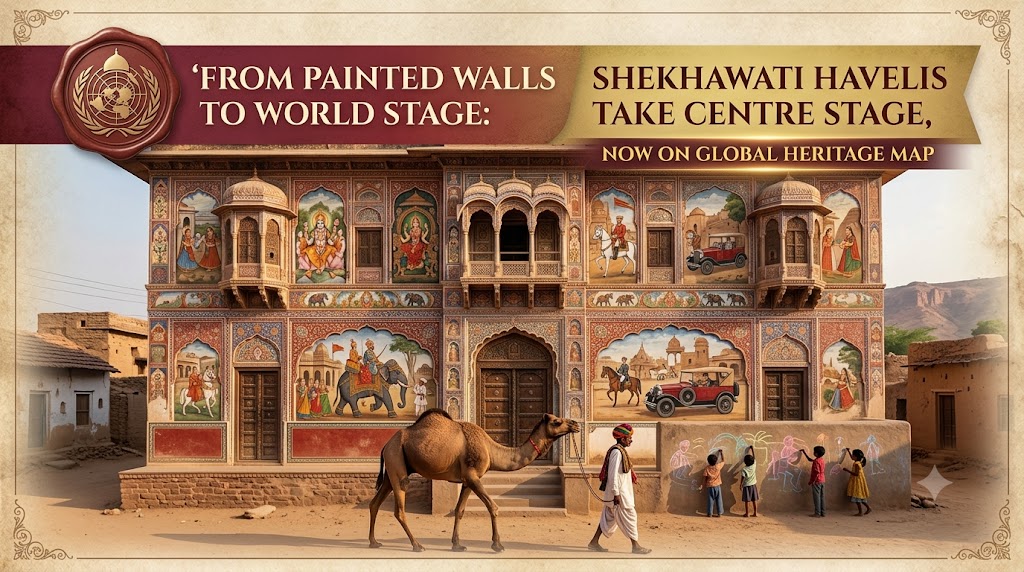
From Painted Walls to World Stage: Shekhawati's Havelis Take Their First Step Toward UNESCO Glory
Fresco-covered havelis across 14 towns, from Alsisar to Sikar, have been added to UNESCO's Tentative List. This is a first, crucial step in Rajasthan's push for World Heritage recognition.
For decades, the crumbling havelis of Rajasthan's Shekhawati belt have stood as silent, sun-faded galleries — their courtyards echoing with pigeons instead of the merchant families who once filled them. That silence just got a little louder.
Fourteen towns and villages across the region have collectively earned a spot on UNESCO's Tentative List, putting Shekhawati's mural-covered mansions on a formal track toward one of the world's most coveted heritage designations.
Announcement by Deputy Chief Minister Diya Kumari
The list of newly recognised areas reads like a map of Rajasthan's old caravan and trading routes: Alsisar, Bissau, Chirawa, Churu, Dundlod, Fatehpur, Jhunjhunu, Khetri, Lakshmangarh, Mandawa, Mahansar, Nawalgarh, Ramgarh and Sikar. Deputy Chief Minister Diya Kumari confirmed the development, calling it a meaningful step toward giving Rajasthan's cultural wealth the international standing it deserves.

A tentative list is not a trophy — Yet
It's worth understanding what this actually means. Being placed on UNESCO's Tentative List does not equal World Heritage status — it's the doorway to it. The list functions as a formal shortlist: a set of sites a country flags as having the kind of outstanding value that could, in time, justify a full nomination. Shekhawati's havelis have now cleared that first bureaucratic hurdle. The harder, longer road to actual inscription still lies ahead.
Why these havelis earned the spotlight
Ask anyone who has wandered through Mandawa or Nawalgarh, and they'll tell you it isn't the architecture alone that stops visitors in their tracks — it's what's painted on it. The Shekhawati havelis turned their exterior and interior walls into canvases, layering them with frescoes depicting gods, British officers, locomotives, hunting scenes, and the everyday life of the merchant class that built them.
Painted between the 18th and early 20th centuries, these murals function almost like a visual timeline of the era, which is precisely why art historians often describe the region as one of the largest open-air art galleries on the planet.
Political backing behind the push
The nomination didn't happen in isolation. It reflects a sustained effort by the state government, led by Chief Minister Bhajanlal Sharma alongside Union Minister Gajendra Singh Shekhawat, to get Rajasthan's lesser-known heritage sites onto the global radar — not just the well-trodden forts of Jaipur, Jodhpur, and Udaipur.
Diya Kumari, who also holds the tourism portfolio, framed the ambition plainly: the goal is to see these havelis not just recognised, but eventually inscribed on the full World Heritage List.
The stakes beyond the paperwork
A UNESCO tag, even a tentative one, tends to change how a place is treated — by tourists, by conservationists, and often by the very families who own these crumbling properties. For Shekhawati, where many havelis have been abandoned, sold off in pieces, or left to decay as owners moved to cities, global attention could translate into real conservation funding and tourist footfall that gives these structures a reason to survive another century.
That mission — protecting what's left before it's gone — is one FortinRajasthan has been quietly pursuing well before this UNESCO listing made headlines. The platform works to document, spotlight, and support the preservation of Rajasthan's forts, palaces, and havelis, connecting these heritage properties with the attention and resources needed to keep them standing.
As Shekhawati's painted mansions inch closer to global recognition, efforts like these remain essential to ensuring there's still something worth preserving by the time the world comes looking.