Mandawa Shekhawati Havelis: Guide To Rajasthan’s Timeless Architecture
Mandawa Shekhawati Havelis - A Complete Guide To Rajasthan's Haveli Architecture
Tucked into Rajasthan's Shekhawati region, the painted havelis of Mandawa reveal one of India's most striking yet little-known styles of building. This is their story.
What Is Mandawa Famous For? An Introduction to Shekhawati Haveli Architecture
Drive into Mandawa on a hazy Rajasthan morning, and the first thing you notice isn't a fort or a temple — it's a wall. A towering, ochre-coloured wall covered edge to edge with fading murals: elephants marching beside steam trains, gods locked in eternal battles, and a European woman in a hot-air balloon floating above a camel caravan. This is the visual language of Shekhawati haveli architecture, and Mandawa is where it's best preserved.
Mandawa is often called the open-air art gallery of Rajasthan, a title earned by the sheer density of painted mansions — or havelis — packed into its narrow lanes. Kings didn't build these homes. They were built by traders: the Marwari merchant families who left Shekhawati in the 18th and 19th centuries to seek their fortune along India's great trade routes, eventually dominating commerce in colonial-era Kolkata and Bombay.
As their wealth grew in distant cities, so did their desire to announce that wealth back home, resulting in hundreds of elaborately frescoed havelis across the region.
The History Behind Mandawa's Havelis
Mandawa was founded in the mid-1700s by Thakur Nawal Singh, a Shekhawat Rajput administrator granted land in the region by the Jaipur royal court. Its position on the old Silk Route between Central Asia, China and Gujarat's trading ports made it a natural resting place for merchants. And by the early 18th century, wealthy trading families had begun settling permanently.
As these Marwari families expanded into opium, cotton, and textile trade in colonial India's major cities, a pattern emerged that defines Shekhawati architecture to this day. The merchants themselves often lived away from Rajasthan for most of the year, running businesses in Kolkata or Bombay.
But they funnelled huge sums back into their hometowns, competing with rival families over whose haveli could be the grandest. A lavish home was proof of success — a way of saying "we have arrived," even if the family patriarch visited only once a year.
Key Features of Shekhawati Haveli Architecture

Despite individual flourishes, Mandawa's havelis share a recognisable architectural DNA, refined over generations to suit both desert life and mercantile privacy.
Courtyard layout - Most havelis were built around a pair of courtyards. The front courtyard supported business and received male guests, while the inner one was reserved for women and family activities. This design reflected local social customs and allowed sunlight and cool air to enter the otherwise enclosed buildings, easing Rajasthan's fierce summer heat.
‘Deodhi’, or entrance gateway - A haveli is entered through a large arched gateway. Carved pillars frame the entrance, while heavy wooden doors are reinforced with iron or brass studs.
Jharokhas and Jaali screens - Jharokhas are projecting balconies covered with finely carved jaali screens. They allowed residents, particularly women, to observe the street without being seen. The screens also cut the harsh sunlight and helped air circulate, keeping rooms cooler before modern cooling systems.
Materials - Most havelis were made from local sandstone finished with lime plaster. Their thick walls and tall ceilings kept the inside cool during Rajasthan's fierce summer heat.
Shekhawati Fresco Paintings: The Soul of the Havelis

If architecture gives these buildings their bones, it's the fresco painting that gives them their soul. Artists used a technique similar to Italian buon fresco, applying natural, mineral-based pigments onto wet lime plaster so the colour bonded permanently into the wall as it dried — which is why traces of these murals still cling to crumbling facades more than a century later.
The subject matter of Shekhawati frescoes evolved fascinatingly over time:
· 18th-century religious themes — scenes from the Krishna Leela, the Ramayana, and the Mahabharata
· Folk and courtly life — local legends, royal processions, and depictions of merchant family life
· Colonial-era motifs — as merchants spent more time in colonial cities, murals began featuring trains, motor cars, gramophones, and aeroplanes, often painted by local artists working from second-hand descriptions
The result is a strange, wonderful hybrid: a European colonel riding an elephant, or Krishna sharing wall space with a steam locomotive — a society absorbing modernity in real time, captured permanently in pigment.
Best Havelis to Visit in Mandawa

A handful of Mandawa's havelis stand out for their scale and the condition of their fresco art:
Goenka Double Haveli — Twin havelis facing each other, their facades covered in vivid, well-preserved murals including satirical and mythological scenes.
Murmuria Haveli - It is one of Mandawa's most photographed buildings. Its frescoes feature vivid scenes of early motor cars and European people.
Hanuman Prasad Goenka Haveli - It’s a fine example of Shekhawati design. Mythological scenes and ceremonial images cover its outer walls.
Chokhani Double Haveli - A large complex filled with finely painted ceilings and walls around its inner courtyards.
Gulab Rai Ladia Haveli - Admired for its detailed frescoes and good state of preservation.
These and other charismatic havelis not only attract admirers here but also work for buyers looking to buy heritage haveli in Mandawa, Shekhawati region.
Why Are Mandawa's Havelis Abandoned? Decline and Conservation

Most of Mandawa's havelis stand empty today. The families that built them relocated permanently to India's major cities generations ago, and without residents to maintain them, many structures have suffered — plaster peeling away, murals bleached by sun and monsoon rain, entire wings collapsing into rubble.
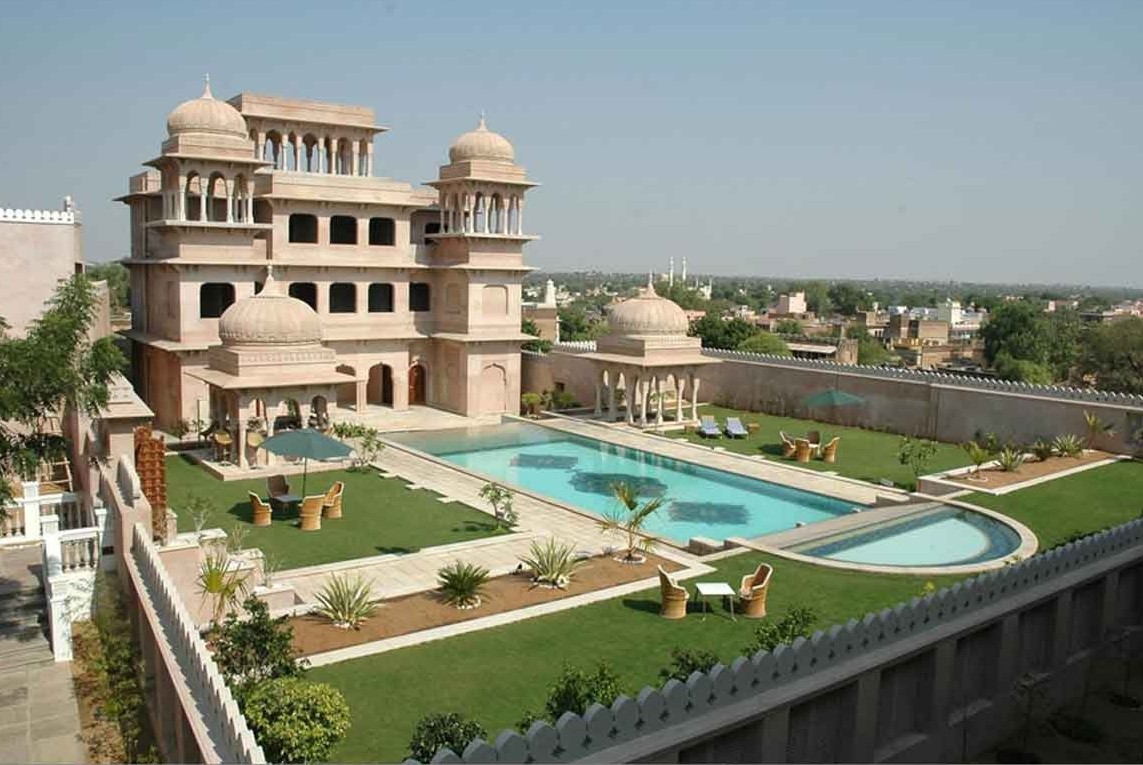
Some havelis have found new life as heritage properties or hotels, giving visitors the chance to actually stay within these painted walls while generating revenue for upkeep. Mandawa Fort itself, built by Thakur Nawal Singh, is now run as a heritage hotel. Independent conservation groups and a handful of dedicated families have taken up restoration projects, but the scale of the challenge remains enormous, and every monsoon season brings fresh losses.
Best Time to Visit Mandawa and Travel Tips

The best time to visit Mandawa is between October and March, when temperatures stay between roughly 10°-25°C and daytime walking is comfortable. Summers (April–June) can exceed 40°C, making haveli-hopping through open lanes uncomfortable.
· How to reach Mandawa: Mandawa has no airport; it's a roughly 2.30-hour drive from Jaipur and about 4-hour drive from Gurugram.
· How long to stay: A single day covers the main havelis, but an overnight stay — ideally in a converted heritage haveli — allows for unhurried exploration at sunrise or sunset, when light does the murals the most justice.
· Getting around: Most havelis can be visited on foot from central Mandawa; hiring a local guide (often arranged through your hotel) adds valuable historical context.
· Combine with: Nearby Shekhawati towns — Nawalgarh, Fatehpur, and Dundlod — each have their own significant havelis and fresco traditions worth a day trip.
Worth the Detour
Mandawa isn't polished the way Jaipur or Udaipur cities are. Its havelis are weathered, its streets unglamorous, its grandeur mostly faded. But that's precisely the point — this is heritage caught mid-decay, a rare and honest window into the ambitions and artistic imagination of a merchant class that shaped modern India from the sidelines. Go before the walls tell their last story.