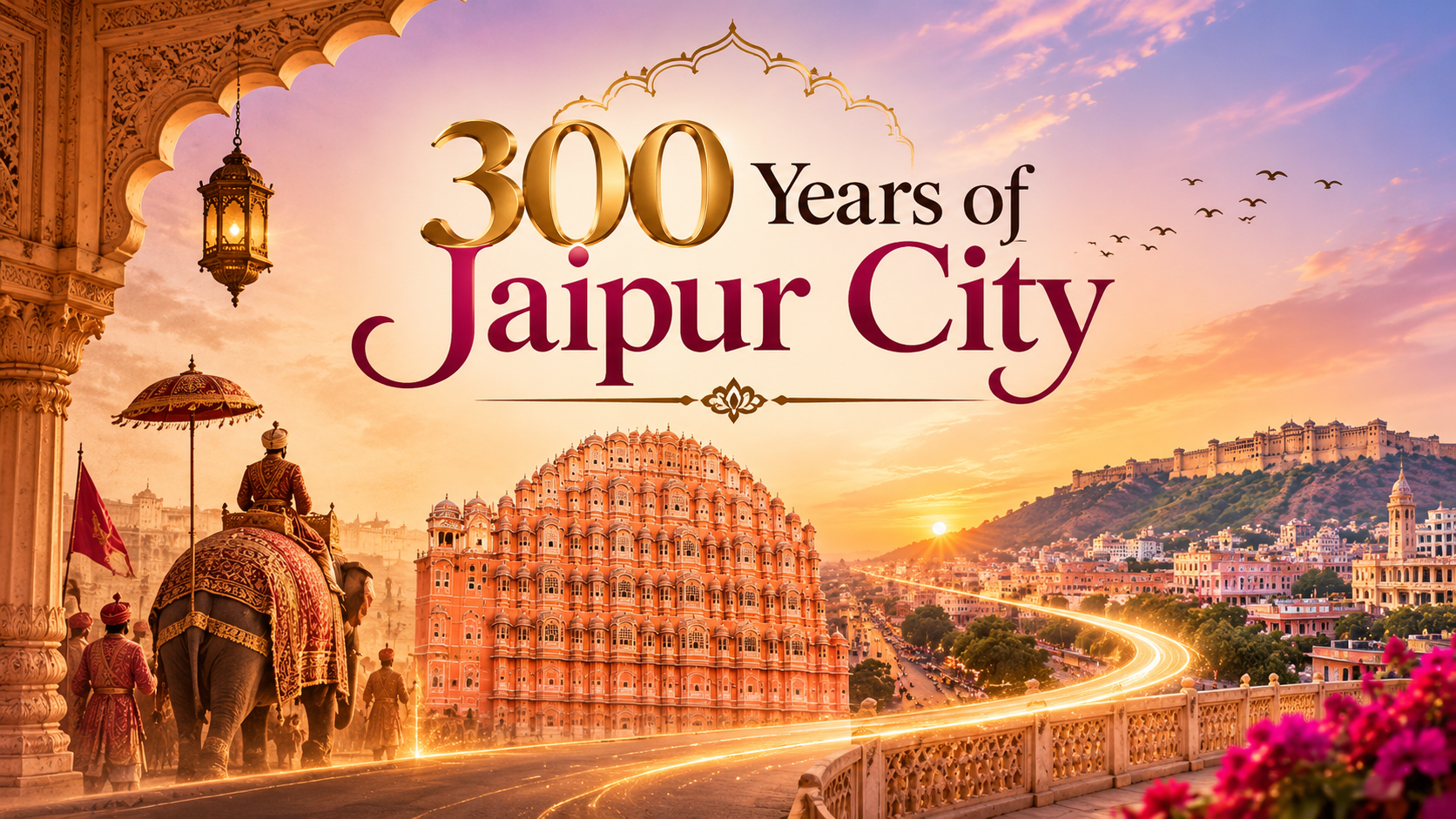
300 Years of Jaipur: How Sawai Jai Singh II Built UNESCO Heritage City and How To See It Today
Jaipur is stepping into its 300th year. Here's the story behind the city, what to see, and how to travel it like someone who actually lives here.
Last week, Jaipur quietly crossed another birthday. The city was founded in November 1727, which means we're now walking into the 300 Years of Jaipur milestone year. Walk through any bazaar or haveli, and you'll feel it. Shopkeepers are freshening up their facades, guides are dusting off their best stories, and old havelis are getting the attention they deserve.
So, if you've been putting off a proper Jaipur trip, or you live here and have never really looked at your own city, this is the year. Let's start at the beginning, with the king who wanted to build something that had never been built before.

The Vision of 1727: How Maharaja Sawai Jai Singh II & Vidyadhar Bhattacharya Designed India's First Planned City
Sawai Jai Singh II was a ruler of Amber, but he was also an astronomer, a maths nerd and a man who got tired of cramped, crowded Amer. The old capital was squeezed between hills, water was scarce, and the population was growing. So, he decided to build a new city on the plains, and he did it with a plan.
He handed the design to Vidyadhar Bhattacharya, a scholar-architect from Bengal who worked from the principles of the Shilpa Shastra, the old Indian texts on town planning. The result was a city of grid-like blocks, wide straight avenues and clearly defined markets. In 1727, when most Indian cities had grown like tangled roots, this was radical.
Pink City architectural layout and motifs
The layout splits into nine rectangular blocks (the chowkris), mirroring the Navagraha mandala. Two blocks hold the royal palace and its grounds. The rest were given over to traders and craftspeople, each trade in its own lane. That's why you still find the jewellers in one place and the cloth dyers in another.
The Pink City architectural layout and motifs didn't stop at the street plan. Look up at any old façade, and you'll spot the same things again and again: scalloped arches, jharokhas (projecting balconies), latticed stone screens called jaalis, chhatris with their small domes, and floral stucco work. The pink colour came later, in 1876, when the city was painted to welcome the Prince of Wales. Pink was the colour of hospitality, and it stuck.
This is the part designers love. Every one of those motifs solves a real problem. Jaali screens cool the air and give privacy. Deep balconies throw shade. Courtyards pull in light and let hot air rise out. It's beautiful, but it's also very smart design.

300 Years of Architectural Wonders: Amer Fort, Hawa Mahal, Jantar Mantar, and City Palace
Four places will give you the whole story, so start here.
Amer Fort is the old capital, sitting high above Maota Lake. Go early. The Sheesh Mahal, with its mirrored ceilings, is the showpiece, but the real magic is wandering the courtyards before the tour buses arrive. The fort belongs to the group of Hill Forts of Rajasthan that earned World Heritage status in 2013.
Hawa Mahal is the one on every postcard. Built in 1799, it has 953 small windows so royal women could watch street life without being seen. Here's a tip: the best photo isn't from the front. Climb to a cafe across the road for the view, then go in and look back at the street from inside the jharokhas.
Jantar Mantar is where Jai Singh's science obsession shows up in stone. It's an open-air observatory of giant instruments, including the Samrat Yantra, the world's largest stone sundial. It reads time to about two seconds. Hire a guide here. Without one, it's just big sculptures. With one, it's a working machine.
City Palace is still partly home to the royal family, and it shows. The museum wings hold textiles, weapons and manuscripts, and the Chandra Mahal and Mubarak Mahal courtyards are some of the finest in the city.
Together, the Pink City and Jantar Mantar are why UNESCO Heritage status matters here. Jantar Mantar was inscribed in 2010, and the walled city followed in 2019, recognised for its town planning and the way trade and culture mix in its streets.

Preserving 18th-century Rajput Havelis
Beyond the big monuments, the city's soul lives in its havelis, the mansions of merchants and nobles with painted courtyards and carved doorways. Many are crumbling. Water seeps in, owners can't afford the repairs, and modern shopfronts chew away at old facades.
Preserving 18th-century Rajput Havelis takes more than fresh paint. It means lime plaster instead of cement, original stone repairs, restored fresco work and wiring that doesn't wreck the walls. Done well, a haveli can live another 300 years. Done badly, it loses what made it special.
The Living Bazaars & Crafts: Johari Bazaar to Blue Pottery - Preserving 3 Centuries of Artisanship
The bazaars aren't a museum. They're the city's working heart, and they've been trading since the first stone was laid.
Johari Bazaar is the jewellery street, famous for gemstones, kundan and meenakari work. Prices are negotiable, and so is the chai. Bapu Bazaar is where you go for block-printed cottons, mojari shoes and lac bangles. Tripolia Bazaar is the place for brass, lacquerware and bandhani.
Then there's Jaipur blue pottery, the pretty cobalt-and-white ceramics made without clay. It's made from quartz stone powder, glass and gum, then fired at low temperatures. The craft nearly vanished in the mid-1900s, until artists like Kripal Singh Shekhawat revived it. Visit a working studio and watch a potter hand-paint a plate. It takes a few minutes, and you'll never look at a mass-produced plate the same way again.
Here's what to look for when you shop:
- Hand-block printing: uneven edges and tiny colour variations mean it's real
- Gemstones: ask for a certificate and buy from established shops
- Blue pottery: it should feel light, with a glassy finish
- Marble and stone work: check the base for chips
How to Celebrate Jaipur's 300th Year: Heritage Walks, Literature Festivals, and Night Tourism
You don't need a special event to celebrate. But a few things make the 300th year better than a normal visit.
Heritage walks. Early morning walks through the old city, led by local historians, are the best way to see the lanes you'd otherwise miss. You'll learn why one street is named after elephants and another after sweet-makers.
Literature festivals. The Jaipur Literature Festival has been one of the most talked about occasions every year. It turns 20 in 2027 and runs from 14 to 18 January at Hotel Clarks Amer.
Night tourism. Jaipur after dark is a different place. Albert Hall glows, Amer Fort has an evening light-and-sound show, and Nahargarh Fort gives you the whole city lit up below. Sunset at Nahargarh is worth the drive on its own.
Heritage homestays and boutique hotel conversion
Here's a trend worth watching in 2026. Travellers are tired of identical glass hotels. They want a room with a story. That's why heritage homestays and boutique hotel conversion has become one of the most interesting shifts in Jaipur. Old havelis and palaces are being turned into small stays with a handful of rooms, family-run kitchens and original paintings on the walls.
If you're booking, ask a few simple questions. Is the building original? Has it been restored with traditional materials? Do the owners live on site? A good homestay answers all three proudly.

Practical Travel Information: Best Time to Visit, Local Food, and How to Get Around
Best time to visit. October to March is the sweet spot. Days are warm, nights are cool, and festival season keeps the city buzzing. Summers run hot, often past 40°C, and monsoon brings humidity but also green hills around the forts.
What to eat. Start with pyaaz kachori at breakfast, then work your way through dal baati churma and laal maas for lunch. Finish with ghewar if you're here around Teej, or a cold lassi any time of year. Don't skip a plate of mawa kachori from a proper sweet shop.
How to get around. The metro is clean and quick for some stretches. Auto-rickshaws and e-rickshaws are fine for short hops, and app cabs work well for the forts. For the walled city, walk. The lanes are narrow, the shops are close, and cars just get stuck.
A few small things help. Wear comfortable shoes, carry water, cover your shoulders at temples, and try to see Amer Fort in the first hour after opening.
Take a Piece of Jaipur Home
The more time you spend here, the more you notice how much of this city's charm lives in small details: a carved jaali, a painted ceiling, a courtyard that catches the evening light. Those same details can shape how you live and work today.
That's where we come in. Along with our interior design team, FortinRajasthan creates complete heritage interiors for luxury homes, apartments and modern corporate offices. From Sawai Jai Singh II-inspired layouts to hand-finished Rajput motifs, we bring the spirit of the city into your space without losing comfort or function.
As the city celebrates 300 Years of Jaipur and its UNESCO Heritage legacy, why not bring a little of that history into your own walls? Get in touch with FortinRajasthan and let's design something that's built to last.