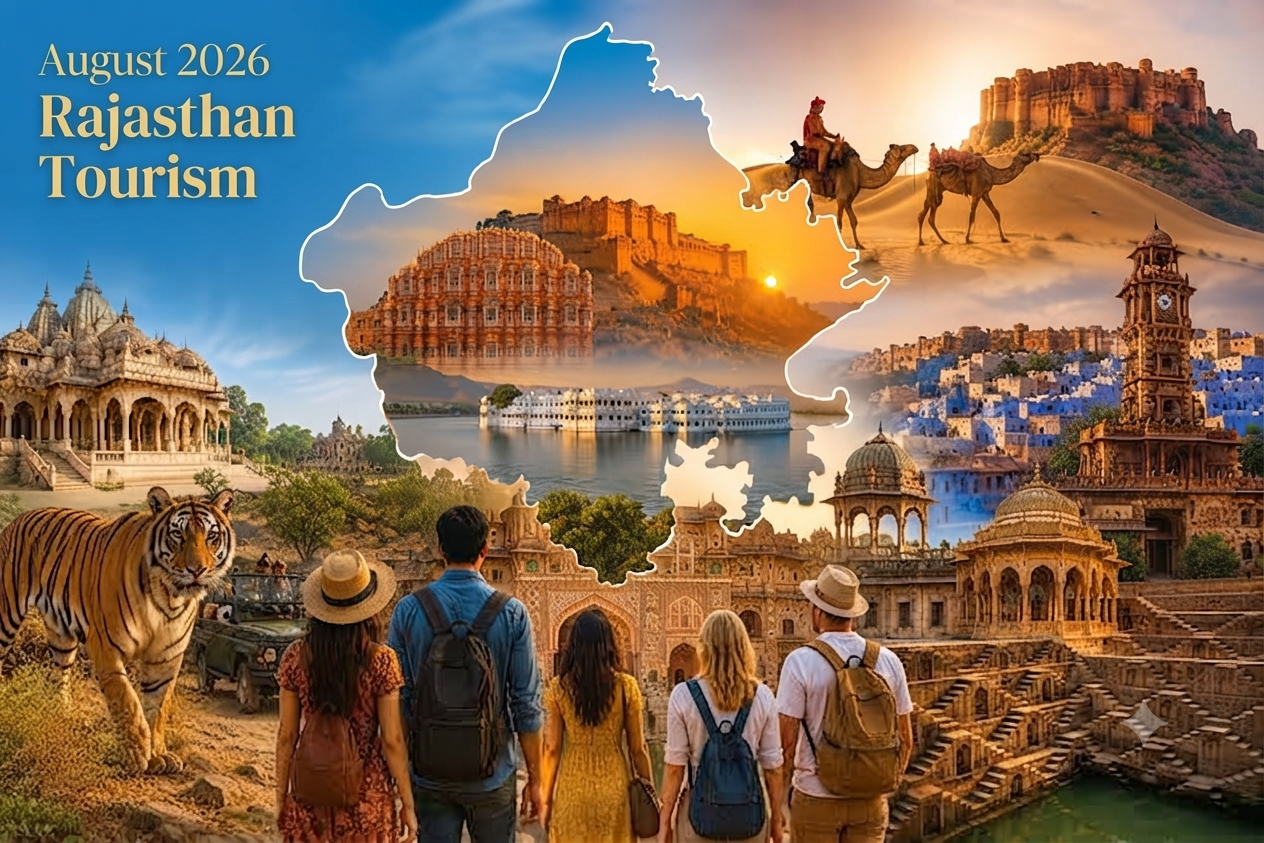
Rajasthan Tourism, August 2026: Record Half-Year Numbers, New Secretary and a Tribal Tourism Push
Nearly 11 crore half-year visitors, a confirmed change of tourism secretary, a Rs 306-crore tribal tourism plan and fresh monsoon disruption — Rajasthan tourism's August 2026 mixed strong data with familiar seasonal setbacks.
August didn't have one big headline event for Rajasthan Tourism. Instead, it was a month built on numbers and planning. But put the pieces together — the visitor data, the new person now running things at Paryatan Bhawan, and a fresh tourism-circuit plan — and you get a clear picture of where the department wants to go as the festival season nears.
Half-Year Numbers: Nearly 11 Crore Visits
The month's biggest data point came in the last week of August: Rajasthan recorded 10,92,04,101 tourist visits between January and June 2026 — 10,83,59,405 domestic and 8,44,696 foreign. Jaipur led international arrivals with 2,56,293 visits, followed by Udaipur, Jodhpur and Jaisalmer. Sawai Madhopur also made the top rankings, a sign wildlife tourism keeps pulling in crowds, and the Kota-Hadoti region logged over 24 lakh visits on its own.

Officials also flagged a smaller trend: January was the strongest month for tourist numbers across Jodhpur, Pali, Barmer, Jalore, Nagaur and Balotra, with Jodhpur's global reputation feeding rural and heritage tourism in nearby districts. Deputy Chief Minister and Tourism Minister Diya Kumari tied the numbers to the Centre's "Dekho Apna Desh" campaign. They said growing both domestic and international visitor share stays a top priority.
A Rs 306 Crore Push into Tribal Tourism
On August 11, the state government put forward tourism projects worth around Rs 306 crore meant to bring Rajasthan's southern tribal belt into the tourism spotlight. The plan involves a new Tribal Tourist Circuit and a Maharana Pratap Tourist Circuit, covering Udaipur, Pratapgarh, Dungarpur, Banswara and parts of Sirohi — districts known for their tribal traditions and old sites.
Officials describe it as a way to promote religious, historical and cultural heritage while also creating local jobs and protecting tribal identity. This is a real attempt to move beyond the desert-and-fort image that dominates how most people think of Rajasthan tourism, and it fits with the tribal-circuit language already used in February's budget announcements around PRITHWI and the Thar Cultural Circuit.
A New Name at the Top: Shuchi Tyagi as Tourism Secretary
The department's leadership churn from earlier this year has settled, at least for now. IAS officer Shuchi Tyagi, from the 2007 batch of the Rajasthan cadre, now holds the post of Secretary, Tourism Department, Art, Literature, Culture & Archaeology. She also chairs RTDC, runs the Amber Development & Management Authority as CEO, and heads the Devasthan Department as secretary — a wide set of charges that took effect from July 21.

Tyagi, who was previously Transport Commissioner and one of four women handed high-profile postings in a 2024 reshuffle, has already shown up at several departmental review meetings this year alongside Tourism Commissioner Rukmani Riar. Her appointment puts tourism, heritage and religious-site administration under one person for the first time in a while — a change from the split and shifting charges that marked much of 2025 and early 2026.
Monsoon Disruption, Again
Rajasthan's active monsoon kept going through August. The IMD put out rain alerts for Jaipur, Bharatpur, Kota and Udaipur divisions on August 9, then issued a stronger warning on August 13 covering Jaipur, Bharatpur, Kota, Ajmer and Udaipur divisions, with heavy rain flagged for eastern and south-eastern districts.
This is much the same pattern seen in July, when similar alerts caused road trouble around Sirohi, Jodhpur and Barmer. It's a reminder that Rajasthan's growing push for green-season tourism in Udaipur, Mount Abu and Kota still runs up against basic road and drainage limits during the heaviest rain weeks.
Looking to September: Two New Travel Marts
August was also when Rajasthan Tourism built out its autumn trade calendar. On August 6, the department and the Federation of Hospitality and Tourism of Rajasthan announced two events: the sixth Rajasthan Domestic Travel Mart (RDTM) in Jaipur, running September 17–19, and the first-ever Marwar Travel Mart in Jodhpur, running September 20–22. Both carry the theme "Stories, Journeys, Smiles" and aim to put lesser-known destinations in front of the domestic travel trade.
Secretary Shuchi Tyagi said travellers now want real experiences, not just a checklist of famous sights, and called for better infrastructure, better connectivity, and closer work with private businesses. Tourism Commissioner Rukmani Riar said the two marts would help Rajasthan's tourism operators build stronger ties with travel businesses from across the country.
Heritage Property Leases: 15 Sites Move Toward Adoption
This is no longer just a policy promise. The Department of Archaeology and Museums has finalised a first-phase list of 15 forts, palaces and stepwells to be handed to private institutions, large families, foundations and other capable organisations under the "Adopt a Heritage" scheme, and sent it to the state government last week.
The list spans all seven divisions and includes Sarwar and Fatehgarh forts and Malkot fort near Merta City (Ajmer circle), the Bhandarej stepwell in Dausa and Bhratruhari and Fatehjang tombs (Jaipur circle), Jalor Fort and the Zenana Mahal at Mandore (Jodhpur circle), Raniji's stepwell, Sukhmahal and Kelwara fort in the Kota circle along with Gagron Fort, and Vaira fort and Talabshahi Bari in Dholpur (Bharatpur circle).
Cabinet approval is the next step. The department says it will retain ownership and control, with adopting organisations helping only with upkeep and tourism promotion, and commercial use will need departmental sign-off.
Internally, though, the process hasn't been smooth — some circle superintendents sent no names at all, others suggested only minor sites, and staff have privately questioned why chronic underfunding for monument upkeep is being solved by outsourcing rather than by simply raising the maintenance budget.
A private consulting firm is reportedly helping draft the scheme's terms. The broader question of leasing or monetising RTDC's loss-making hotel stock remains separate and still open, with past attempts at private handover repeatedly drawing union and political resistance.
The Wider India Context
Rajasthan's numbers sit inside a mixed national tourism picture. Ministry of Tourism data for full-year 2025 shows foreign tourist arrivals fell 8.07 per cent to 9.15 million, even as domestic tourist visits jumped 45.55 per cent to over 428 crore and foreign tourist visits (a separate, broader measure that includes repeat and NRI-adjacent travel) rose 21.36 per cent to 25.27 million.
Tourism contributed Rs 15.73 lakh crore to the economy in 2025 — 5.22 per cent of GDP — and supported 84.63 million jobs. The latest available monthly snapshot, for June 2026, shows foreign arrivals of 584,063, up 3.33 per cent year-on-year, suggesting the inbound dip may be steadying.
The GST cut from September 2025, which brought room-tariff tax down from 12 to 5 per cent for stays up to Rs 7,500 a night, is still cited by the industry as good news for budget and mid-range hotels through 2026. At the same time, the IMD's August bulletins warned of flash floods and highway trouble in other tourism-heavy states too, including Gujarat, Maharashtra and Madhya Pradesh. Monsoon disruption is a problem for India's whole tourism economy this year, not just Rajasthan's.
Bottom Line By Fort In Rajasthan
August 2026 was a steady month for Rajasthan Tourism: strong half-year visitor numbers, a settled leadership structure under Shuchi Tyagi, and a genuine push into tribal tourism, all playing out against the same monsoon disruption and unresolved heritage-leasing questions that have followed the sector all year. September's two travel marts will be an early test of whether all this planning turns into real momentum on the ground.