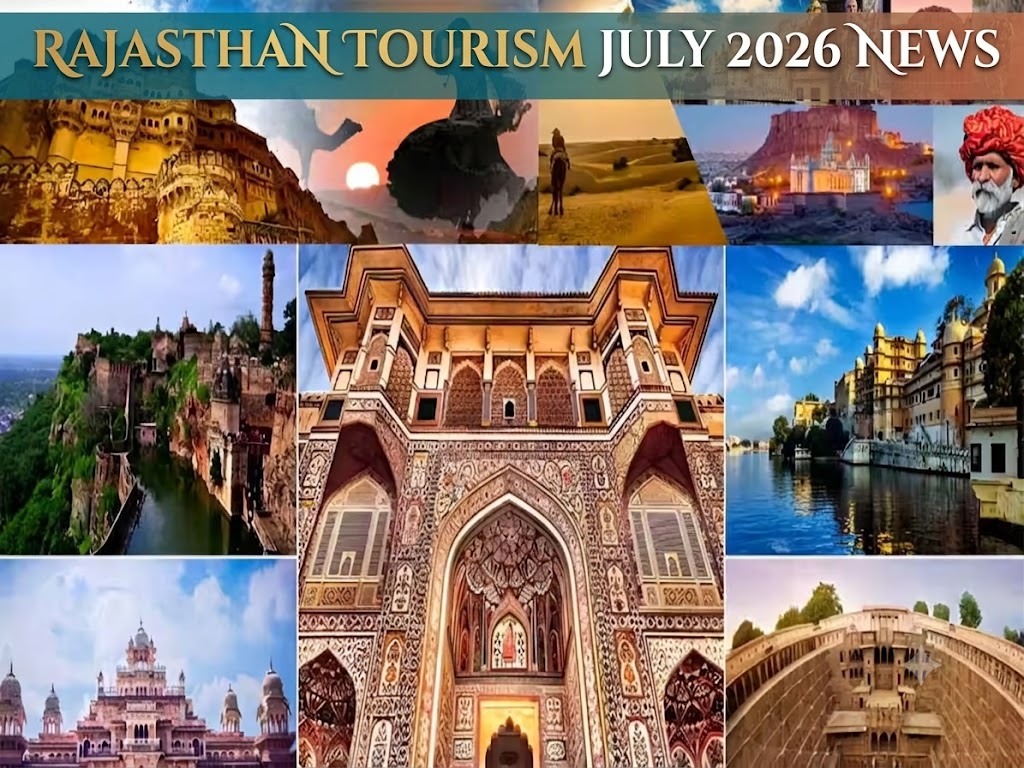
Rajasthan Tourism July 2026 Round Up: National Awards, Ministerial Review and Monsoon Disruption
Four national awards, a stalled-project review and monsoon disruption marked Rajasthan tourism's July 2026 — with festival season, trade fairs and unresolved heritage-leasing questions ahead.
Rajasthan's tourism sector moved on several fronts through July 2026 — national branding wins, a high-level review of stalled projects, and disruptive monsoon rain — against a backdrop of a bureaucracy still settling into reshuffled roles and a heritage-property debate that never fully goes away.
Here is what happened this month, plus the context needed to make sense of it.
Four National Awards in Three Weeks

July 2026 was a strong month for Rajasthan Tourism's national branding push.
· The tourism department's pavilion won the "Award for Excellence" at the Travel and Tourism Fair in Kolkata (July 10–12), "Best Luxury Destination" at the India International Travel Mart in Chennai (July 16–18), and both "Best Heritage Tourism Destination of the Year" and "Destination of the Year" at the India International Travel Mart in Bengaluru (July 23–25).
· Officials also represented the state at a heritage tourism conclave in Hyderabad on July 24. Tourism Commissioner Rukmani Riar and Joint Director (Marketing) Ajay Sharma credited the wins to sustained B2B outreach and digital pavilion presentations spanning heritage, wildlife, rural, wellness and film tourism.
Deputy CM's July 28 Review: Money Moving, Slowly

The month's most substantive administrative development came on July 28, when Deputy Chief Minister and Tourism Minister Diya Kumari chaired a review meeting at Paryatan Bhawan and pushed for faster ground-breaking on stalled projects.
· The numbers show a department managing a very large pipeline: of 72 budget announcements made between 2024-25 and 2026-27, only six are complete, though work is underway on 19 of the 23 new announcements for 2026-27.
· The department has drawn investment proposals worth Rs 1,79,465 crore across 2,094 MoUs; land allocation has been made for 1,359 of them, and ground-breaking has occurred for 332 projects, with a target of 127 more (worth Rs 7,247.87 crore) by December 2026.
· The meeting also surfaced heritage-specific progress: a detailed draft of the Shekhawati Haveli Conservation Scheme 2026, meant to turn the region into an "Open Art Gallery" through scientific fresco conservation. This will include renovation plans for Jaipur's Albert Hall Museum and Ravindra Manch; empanelment of heritage consultants; and restoration of the state's historic step-wells (baoris).
· Kumari also flagged the Rs 206.87 crore Maharana Pratap Circuit project, plans to develop the Tanot Mata Temple into a major faith-tourism site, and progress on an AI-enabled tourist-facilities app.
Monsoon Disruption Mid-Month
Tourism infrastructure took a hit from an active monsoon spell in the second half of July. The IMD issued Orange and Yellow alerts as heavy rain lashed Sirohi, Jodhpur, Barmer, Pali and Jalore around July 25, with Mount Abu recording 195 mm in a single day and Jodhpur seeing knee-deep waterlogging on several roads.
More than 40 previously dry dams have received fresh inflows since early July, and reservoirs, including the Morel Dam (Dausa) and the Mansagar Dam (Tonk), have reached the overflow stage. That’s good news for water security but a reminder that Rajasthan's expanding monsoon-tourism push (Udaipur, Mount Abu, Bundi and Kota are increasingly marketed as green-season destinations) still runs into basic road and drainage limitations during peak rainfall weeks.
Policy Foundations Still in Play

Much of what the department is executing on in July traces back to earlier decisions this year. The Rajasthan Tourism Policy 2025, unveiled in December, set up District Tourism Development Committees under collectors and a Policy Implementation Unit meant to drive investment, digital tourism and visitor safety.
· The February 2026 state budget carved out an ultra-luxury Special Tourism Zone at Khuri near Jaisalmer, a facilitation centre at Kuldhara, and the Rs 200 crore Shekhawati conservation allocation now being fleshed out in the July review.
· That same month, the department also loosened the Rajasthan Homestay Scheme 2026, raising the room cap from five to eight and bed limit from 15 to 24, scrapping the owner-residence requirement, and moving registration to a single-window digital system — a reform aimed at rural and women-led operators, coming off 2025 visitor numbers that topped 25.44 crore, up 9.74 per cent year-on-year.
More From the Month: Fresh Data and a Jodhpur Review
Rajasthan drew nearly 62 million tourist visits in Q1 2026 — 61.29 million domestic, 698,458 international.
· Amer Palace tops international footfall and Jaisalmer dominating the domestic top ten, Joint Director Daleep Singh Rathore said.
· Separately, Deputy CM Diya Kumari visited Jodhpur on July 26, inspecting the historic Sumanohara Baori at Mandore and ordering a conservation and restoration plan, along with a phased development plan for the Government Museum in Mandore Garden.
· She flagged an upcoming water-laser show at Mandore Garden to showcase Jodhpur's heritage, new adventure-tourism activities there, and reviewed budget-funded infrastructure work underway at Kaylana Lake.
Heritage Property Leases: Unfinished Business

No single heritage-property transaction made news in July, but the underlying tension around leasing or auctioning forts, havelis and RTDC's loss-making hotel stock remains unresolved.
· Properties such as Sarwad, Badnor and Shahbad forts have historically been offered on long lease for conversion into boutique hotels, and past attempts to hand loss-making RTDC properties like Khasa Kothi to private operators have triggered union resistance and, at least once, Assembly uproar over claims that assets were being quietly negotiated away to foreign firms.
· The long-running Dholpur Palace dispute remains the cautionary precedent industry watchers cite. With Tourism Policy 2025 promising simplified norms for converting heritage buildings into hospitality assets, this is a debate the July review didn't touch, but that still shapes how aggressively the state can move on heritage tourism.
The Wider India Tourism Context
Rajasthan's push sits inside a national tourism picture that is solid but uneven month to month. Ministry of Tourism data puts international arrivals to India at 20.57 million for 2024, while monthly arrivals through early 2026 swung from roughly 10.07 lakh in January to about 5.34 lakh in April, reflecting seasonality rather than a slowdown.
Domestic tourism remains the real driver, with over 303 crore domestic visits recorded nationally, and central Swadesh Darshan 2.0 funding continues flowing to Rajasthan projects such as the spiritual-tourism development at Bundi's Keshavraipatan. Hospitality bodies in the state continue lobbying for a dedicated tourism board and formal industry status for hotels.
What's Coming Next?
Festival season picks up almost immediately after the monsoon:
· Kajli Teej in Bundi falls in mid-August, followed by the state's wider Teej and Janmashtami celebrations.
· Autumn brings the bigger draws — the Marwar Festival at Jodhpur's Mehrangarh Fort in early October, the Rajasthan International Folk Festival (RIFF) in Pushkar around October–November, and the Pushkar Camel Fair in November. The camel fair is still the state's biggest livestock-and-culture spectacle and a major foreign-tourist pull, followed by the Bundi Festival and Chandrabhaga Fair.
· On the trade side, Rajasthan Tourism is expected to keep up the pavilion circuit it ran through July, with further India International Travel Mart and Travel & Tourism Fair editions across Indian cities into the autumn.
· Moreover, there will be international outings at PATA Travel Mart (Kuching, Malaysia, mid-August) and World Travel Market London (early November).
· Whether the department can convert this run of fairs into measurable footfall gains, and whether the July 28 review's stalled-project numbers move before the December 2026 deadline Kumari set, will be worth watching.
The Bottom Line By Fort In Rajasthan
July 2026 was a genuinely busy month for Rajasthan Tourism: four national awards, a ministerial stock-take on a large and only partially executed project pipeline, and monsoon rain that disrupted roads even as it filled reservoirs.
Behind the headlines, the same structural questions persist — a leadership bench that keeps rotating, and a heritage-asset strategy still searching for a formula that avoids the controversies of the past.