Haveli Interior Design: How Designers Keep Frescoes, Jharokhas and Courtyards Intact
Old havelis aren't just buildings. They're memory, held in lime plaster and carved sandstone. Here's how good designers make them liveable again without wiping out the very things that make them special.
Walk into a Shekhawati haveli on a quiet afternoon, and you'll feel it. Painted elephants march across a faded wall. Light drops through a lattice window in tiny geometric pieces. The courtyard holds the cool air like a cupped hand.
Now picture someone dropping in a glossy false ceiling and a wall of vitrified tiles. That's the nightmare every owner fears, and it happens more often than you'd think. Good haveli interior design in India is the opposite of that. It's about adding comfort, wiring and style while the original craft stays right where it is. Let's walk through how it actually works.

Start By Reading The Building, Not Drawing On It
Before a single mood board gets made, serious designers spend days just looking. They map cracks, damp patches, repairs from earlier decades, and the spots where someone, years ago, painted over something beautiful.
This stage feels slow, and it's meant to. A haveli is layered. The 1880s version might sit under a 1940s upgrade, which sits under a 1990s "modernisation" nobody's proud of. Designers photograph everything, measure every opening, and note which materials are original: lime plaster, local stone, teak or sheesham woodwork, brass fittings.
Most good teams also bring in a conservation specialist early. That person can tell you what's solid, what's dying, and what looks old but is actually a recent patch. Skip this step, and you'll pay for it later, usually in the middle of a monsoon.
Why Haveli Interior Design Starts With The Frescoes
Frescoes are the most fragile treasure in the house. The classic Rajasthani technique, painting on wet lime plaster, bonds colour into the wall itself. It's tough in some ways and shockingly delicate in others.
Here's what designers do, and what they avoid:
- They test before they touch. A tiny patch gets cleaned first, to see how the pigment reacts. Natural mineral colours behave very differently from later paints.
- They fix the cause, not the symptom. A flaking painting usually means moisture is getting in somewhere. Seal the roof leak or the rising damp first, or the repair is wasted.
- They never repaint. Conservators consolidate, clean and, where needed, do light in-painting that can be told apart from the original. Nobody wants a "refreshed" fresco that looks like a cartoon.
- They protect the walls during the work. Dust sheets, careful scaffolding and zero casual drilling. One misplaced hole can cost a century of art.
Then comes the clever part: designing the room around the fresco. Lighting is a good example. Harsh spotlights fade pigments and flatten the painting. Soft, warm, indirect light, placed well away from the surface, lets the artwork glow without cooking it.

Jharokhas: Let the Light and Air Do Their Job
The jharokha, that overhanging carved balcony, is a haveli's signature move. It was never just decoration. It let women of the household watch the street, caught breezes, and threw patterned shade into the rooms.
When a designer respects a jharokha, they keep three things working: the stone or wood carving, the airflow, and the view. That means resisting the urge to glaze it shut with big sheets of glass. If a family wants more insulation or noise control, there are gentler fixes, like discreet inner shutters or slim, reversible glazing set well back from the carved face.
Wood needs its own care. Old teak and sheesham brackets often carry termite damage or rot hidden from view. Skilled carpenters repair rather than replace, splicing in matching timber and carving to match the original pattern. A replaced jharokha is a copy. A repaired one is still the real thing.

The Courtyard Is the Lungs of the House
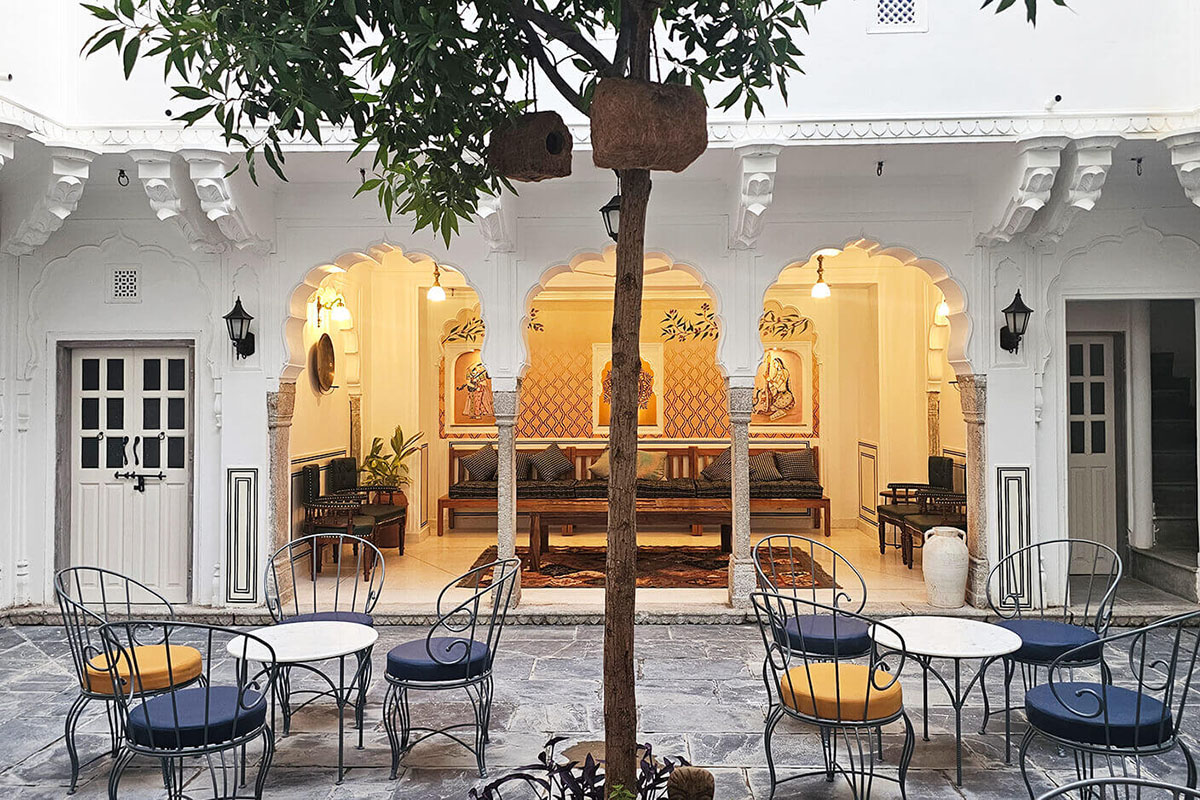
If the frescoes are the soul of a haveli, the chowk, or central courtyard, is its lungs. It pulls cool air down, pushes hot air up, and gives every room around it a bit of sky.
The biggest mistake? Roofing it over to gain floor space. People do it for a bigger living room or a banquet area, and the whole house quietly stops breathing. Rooms get stuffy, damp creeps in, and the cooling trick that worked for 150 years is gone.
Smart designers keep the courtyard open and make it earn its keep. A few ideas that work:
- Shade it softly. Light canopies, retractable fabric or slender pergolas can cut midday glare without sealing the space.
- Bring back water. A small fountain or shallow pool cools the air naturally and sounds lovely.
- Plant carefully. A tulsi, a pot of marigolds or a single tree adds life, as long as roots stay away from old foundations.
- Mind the floor. Original stone or lime flooring should be cleaned and repaired, not buried under fashionable tiles.

Heritage Property Restoration: Unglamorous Work That Saves Everything
Nobody posts photos of drainage on Instagram. But heritage property restoration is mostly this kind of invisible work, and it decides whether the pretty bits survive.
Walls are the big one. Old havelis were built with lime mortar, which lets walls breathe and release moisture. Modern cement doesn't. Slap cement plaster over a lime wall and the water gets trapped, then pushes out through the paint or fresco. It's one of the most common and most expensive errors in haveli work.
So, the right team uses lime-based mixes, traditional methods, and materials sourced to match. They'll also handle things you can't see:
- Modern wiring and plumbing, run through hidden channels rather than hacked into walls
- Fire safety, which is a real issue in old timber-heavy buildings
- Structural checks on beams, arches and foundations
- Proper rainwater drainage for the roof and the courtyard
Done well, you can't tell any of it is there. You just get a haveli with working AC, hot water and decent Wi-Fi that still looks like it did in 1890.

Luxury Without Losing the Story
Here's where luxury heritage interior design gets interesting. The goal isn't to make a haveli look like a five-star hotel. It's to give people modern comfort in a way that feels like it belongs.
Think of a bathroom tucked behind a screen, finished in hand-polished lime plaster. Or a kitchen built into an old storeroom, with the original arch left visible. Furniture matters a lot here, too. Good heritage furniture and interior design mixes restored antiques, hand-carved pieces and clean contemporary shapes in a way that lets each one breathe. A crowded room hides the architecture. A calm one shows it off.
Colour is another trap. The safest palette is the one the building already offers: warm ochres, indigos, terracotta, and the soft off-white of lime wash. Pull your accents from the frescoes themselves, and the whole house hangs together.
Textiles do heavy lifting, too. Block-printed cottons, handloom dhurries and silk cushions bring warmth and colour without a single nail in the wall.
How to Pick the Right Team
A haveli isn't a flat in a new tower. Not every interior firm can handle one, and the wrong choice is hard to undo. Here's what to look for:
- Proven heritage work. Ask to see completed havelis, forts or palaces, not just modern homes.
- Local knowledge. Heritage interior designers in Rajasthan understand the climate, the stone, the lime, and the craftsmen who still know the old techniques.
- In-house or trusted craftspeople. Lime masons, wood carvers, fresco conservators and metalworkers should be part of the plan from day one.
- Reliable haveli renovation contractors. The best designer in the world can't help if the site crew uses cement on a lime wall.
- A willingness to say no. Great designers tell you what shouldn't be touched, even when you'd like to.
Ask about timelines, too. Real restoration takes longer than a regular fit-out, because lime needs time to cure and conservation can't be rushed. Anyone promising a haveli makeover in six weeks is either cutting corners or not telling you everything.
The Bottom Line
A haveli doesn't need to be frozen in time, and it shouldn't be turned into something it's not. The sweet spot is in between: frescoes cleaned and protected, jharokhas still carved and breathing, courtyards open to the sky, and every modern comfort tucked quietly out of sight.
Get the order right, and the rest follows. Study first, repair second, decorate last.
Ready to Bring Your Haveli Back to Life?
Thinking about a heritage home, or a modern space with a touch of Rajasthan in it? FortinRajasthan works hand in hand with its in-house interior design division to deliver complete haveli interior design and heritage-inspired interiors, whether it's a luxury residence, an apartment, or a sharp, modern corporate office.
Get in touch with FortinRajasthan today and let's talk about what your space could become.